
Repair, Don’t Replace: When Smarter Surface Solutions can be used in Social Housing

Last week I came across the Inside Housing Repairs Tracker 2026, which reported that English housing providers increased spending on repairs for the fourth year in a row, reaching yet another record high. I can’t see the full figures behind the paywall, but, from what I see on the ground, it doesn’t come as a surprise. There are obviously lots of factors involved, but in my experience, figures and statistics rarely tell the full story of why things are the way they are. Over the years, I’ve raised many of these issues with managers, often to little avail, yet they continue to shape the way repairs are managed across social housing.
Materials, systems, and productivity are obviously big factors, and the UK has some of the oldest housing stock in Europe, which brings its own challenges. All of those subjects deserve their own articles, so I won’t go into much detail on them in this one. But from where I stand on the ground, seeing repairs day in and day out, it’s clear that a lot of money is being spent unnecessarily; the sector could be working much smarter. That’s why today I want to focus on surface repairs: what can be done to restore baths, sinks, worktops, doors, tiles, kitchen cupboard doors, and windows, rather than replacing them entirely.
A lot of the damage I see every day isn’t structural. It’s cosmetic. A chipped bath, a scratched sink, chipped worktops, a scuffed door, a cracked tile, a damaged window surface, or a scratched kitchen cupboard door. Functionally, these things often work perfectly. The bath still holds water, the doors open and close, the worktop can still take the weight of a kettle. But in the system, the default is often “rip it out and replace it,” which creates unnecessary costs, disruption, and waste.
In many properties I visit, there’s something minor that could be repaired rather than replaced. Baths and sinks have small chips. Worktops are scratched, edges chipped, or laminate worn down. Doors get dents or scuffs on the painted or laminate surfaces. Tiles can crack or chip. Window surfaces get minor cracks or dents. Kitchen cupboard doors often suffer scratches or chipped laminate on the fronts. Alone, each of these issues seems minor. But across hundreds or thousands of homes, the replacements rack up quickly, and so does the waste. I’ve loaded skips full of materials that were mostly fine, just because the surface was damaged. Watching all that perfectly good material go to landfill makes you realise how much unnecessary cost and environmental impact comes from choosing replacement over repair.
Additionally, it’s the impact full replacements have on tenants. For example, when worktops are removed or baths replaced, it often triggers further work; tiles may need to be taken out and replaced, cupboards may be removed, and surrounding surfaces repaired. This can put kitchens or bathrooms out of action for the day or even days, making daily routines difficult and stressful, particularly for families, elderly tenants, or those with health conditions.
Another issue with replacing components like worktops or kitchen cupboard doors is that the original colour, style, or design may no longer be available. This often means new items have to be matched as closely as possible, which can result in kitchens or bathrooms looking patchy or unsightly. Understandably, this can lead to tenant dissatisfaction. Many managers I’ve worked under foolishly dismiss their concerns, focusing solely on functionality rather than the visual impact for tenants. Even though they wouldn’t accept this in their own home. As a result, formal complaints are raised and escalated, and in many cases, the resolution ends up being a full kitchen replacement.
These situations highlight my point: many of the issues with full replacements could be avoided if the focus shifted to repairing the existing surfaces. Instead of stripping out entire kitchens or bathrooms, restoring what’s already there can maintain the home’s look, keep tenants happy, and save time and money.
Professional surface repair is proving to be a viable solution. I’ve seen on LinkedIn recently that some housing providers are bringing in specialist repair companies that focus on restoring the material itself, rather than replacing it. They can bring baths, sinks, worktops, doors, tiles, kitchen cupboard doors, and window surfaces back to near-original condition using techniques like colour-matched resins, fillers, sanding, polishing, and protective coatings. From my perspective, the benefits are obvious. Repairs usually take just one to three hours per surface, compared with days in some cases for a full replacement. The finished work is often indistinguishable from new. Materials stay out of landfill, budgets stretch further, and on larger jobs, tenants aren’t disrupted while the work is carried out.
Kitchen worktop surface repair -
UPVC door surface repair -
https://youtube.com/shorts/xdLl3GWKL0Y?si=hBYnfmu3un7b4Zp4
Laminate floor surface repair -
Heat gun repairs are another area where surface restoration can make a real difference, particularly for UPVC doors and windows. Many people assume that once the plastic is dented or buckled, often after an attempted break-in, the only option is full replacement. In most cases, however, these surfaces can be restored using a simple heat gun technique. By carefully applying heat, compressed or buckled UPVC can be reshaped back to its original condition. When done properly, the surface looks almost as good as new, avoiding the cost, waste, and disruption of a full replacement. The equipment is inexpensive, you can pick up a heat gun for under £100, and the training is quick; I was able to learn the technique in less than half a day. It’s a straightforward, practical solution that saves money and materials, yet it’s often overlooked.
Woodgrain foil repairs are also possible -
The work doesn’t always have to be subcontracted out. There are courses available that allow trade staff within a DLO to be trained to carry out these repairs themselves. With a bit of training, operatives can learn to restore baths, sinks, worktops, doors, tiles, cupboard doors, and UPVC surfaces quickly and effectively. This approach keeps expertise in-house, reduces costs, and allows housing teams to respond faster to repair needs.
Of course, a common-sense approach is essential. If a surface or component is extensively damaged, beyond what can reasonably be repaired, attempting to fix it may take too much time or resources, and replacement becomes the more practical solution. The key is knowing when a repair will restore functionality and appearance efficiently, and when the damage is simply too great to fix effectively. Repair isn’t a one-size-fits-all solution, but in most cases, it’s the smarter, faster, and more responsible approach.
Every replacement carries a hidden environmental cost. Manufacturing new baths, sinks, worktops, doors, tiles, cupboard fronts, and windows uses raw materials such as acrylic, porcelain, timber, laminate, and glass, and requires energy for production, packaging, transport, and installation. When old materials are discarded, they often end up in landfill, adding hundreds of kilograms of waste per property. Repairing surfaces instead of replacing them keeps materials in use, reduces waste, and lowers carbon emissions.
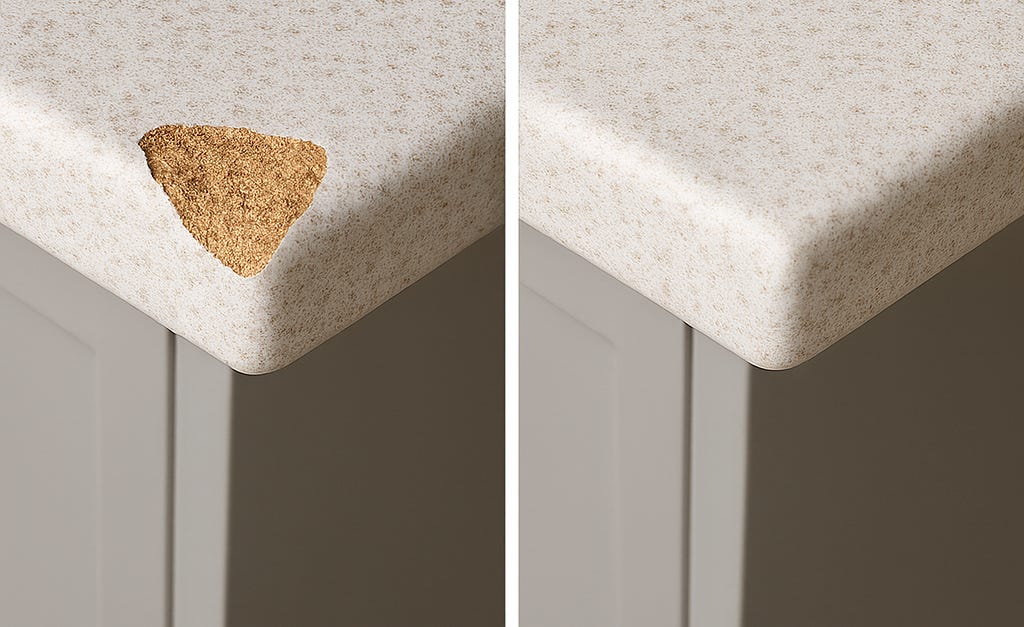
Image: Before and after picture of a surface repair to a worktop.
The impact goes beyond individual homes. Globally, the built environment consumes roughly half of all extracted raw materials, generates about a third of overall waste, and contributes at least 40 % of carbon dioxide emissions, with up to 30 % of building materials wasted before they are even used. In the UK, the problem is even more pronounced: in 2014, the country produced 202.8 million tonnes of waste, with 59 % coming from the Construction, Demolition and Excavation (CDE) sector, and around 75 % of construction waste that could be recycled or repurposed still ended up in landfill. By prioritising repair, reuse, and refurbishment over unnecessary replacement, housing providers can reduce both material waste and energy use while supporting broader sustainability goals.
From where I stand, repair-first approaches make operational sense. Repairs are usually cheaper and faster than full replacements, allowing teams to turn around routine jobs more quickly and, on void properties, get homes ready for re-letting sooner. Extending the life of existing materials also helps reduce long-term capital expenditure. Surface restoration isn’t a compromise; when the damage is cosmetic, it’s often the smarter option. It saves money, minimises disruption to tenants, and lowers environmental impact. Small, intelligent maintenance decisions can add up to significant benefits for both tenants and providers.
With many tenants now able to upload photos of repair issues directly to housing providers, maintenance teams can often assess and diagnose issues like surface repairs before even arranging an appointment. The job can then be allocated to trained operatives or specialist subcontractors, which means that, in many cases, a first-time fix can be achieved, avoiding unnecessary follow-ups or multiple visits. For example, a chipped bath, chipped worktop, dented door, or damaged tile can often be fully restored in a single visit, saving time, reducing disruption for tenants, and stretching maintenance budgets further.
Surface damage is inevitable in social housing, but replacing the entire component is not always necessary. By repairing baths, sinks, worktops, doors, tiles, kitchen cupboard doors, and windows, providers can save money, reduce void turnaround times, minimise disruption to tenants, and lower environmental impact. From my experience on the ground, repair is often the smarter, faster, and more responsible approach. Sometimes the best way to fix a home is simply to restore what’s already there, rather than replace it.
Joe
Thanks Joe