
“That’ll do. It’s only council”

A LinkedIn post I saw recently about taking pride in your work and never settling for a “that’ll do” attitude reminded me of someone I used to work with years ago.
Looking back, it was obvious he was in the wrong profession. His workmanship was consistently poor, and he often showed little regard for the people whose homes he was working in. At times, his work resembled that of an inexperienced DIYer more than a qualified tradesperson. Yet despite this, he was regularly one of the department’s top performers because his jobs-per-day figures were consistently high. What those figures never reflected was the number of recalls he and often his colleagues had to attend to rectify the faults and mess left behind.
The LinkedIn post reminded me of him because he had a phrase he used now and again when working.
“That’ll do… it’s only council.”
Some of the other operatives laughed when he said it, but I never found it funny. To me, those words summed up his attitude perfectly. It wasn’t just about accepting poor workmanship; it was about believing that because the tenant lived in social housing, they somehow deserved a lower standard than everyone else.
One day a planner paired me with him to replace a rotten kitchen unit and a worktop. It would be the first and last time I ever worked with him.
Once we’d removed the old worktop, I started scraping the old sealant off the wall tiles while he measured up and went off to cut the new one. He cut it and then called me over to help lift it in, and as soon as we tried to fit it, it was obvious he’d cut it about an inch too short. He also hadn’t bothered to scribe it to the wall, leaving a sizeable gap along parts of the back. To make matters worse, he hadn’t turned it over before cutting, so the saw blade had chipped the laminate edging all the way along the cut edges.
I said we’d have to order another worktop. He looked at me as though I’d completely missed the point before telling me not to be daft because the sealant would fill the gaps and cover the chips.
He then suggested we tell the office we needed more materials to finish the job so we could go to the suppliers and get more time added on. In this case, the materials he claimed we needed was sealant, even though I told him I already had some on my van.
“So have I,” he laughed, “but I don’t want to do any more work after this.”
It was just after midday.
Some people reading this may never have heard the term “ghost run”. It’s not a particularly well-known expression, but it’s one I’ve heard other tradespeople use when they are going to the suppliers for materials they already have on the van simply to stretch out the time on a job.
Over the years I’ve seen all sorts of time-wasting tactics. I’ve known operatives claim they needed to return to the yard to clear rubbish from their van when there was nothing to dispose of, simply because it gave them an excuse to waste time. Others claim their van is full to the brim of rubbish and they can’t move when all they have is one black bag. This is a tactic that seems particularly popular towards the end of the working day so that they can see out the rest of the day sitting in the yard rather than go out and do another job. I’ve seen others insist that materials were out of stock at one supplier, even when they weren’t, just to justify driving to another branch and adding another hour or more to the job.
None of this improves the service for tenants. It simply wastes time, money and resources while reinforcing the wrong behaviours.
There's no great revelation here. If you've worked as a planner, supervisor or manager in a repairs service, you'll probably know these sorts of things can and do happen. The difficulty is proving it. When you're responsible for a number of operatives, hundreds or thousands of properties and an endless stream of repairs, it's impossible to monitor every movement throughout the day. Most organisations rely on trust, and rightly so. The problem is that a small minority will always take advantage of that trust if they think they can get away with it.
It’s also worth pointing out here that this isn’t every operative and it’s not every organisation or repairs team. The vast majority of tradespeople I’ve worked alongside throughout my career take pride in what they do and find this attitude completely unacceptable. Unfortunately, the actions of a small minority affects the rest and additionally it reinforces the negative stereotypes that many good tradespeople in social housing already face. One of my next articles will look at the stigma attached to tradespeople who have worked or work in social housing not only from wider society, but sometimes when they try to move into new roles in other sectors and employers question the quality of their previous experience.
So off we went. Two operatives. Around thirty minutes to the suppliers, another thirty minutes with him standing around chatting in the yard, then thirty minutes back again. Roughly an hour and a half had passed before any more work was done.
When we got back, he picked up a tube of black sealant. The worktop was black and so he proceeded to fill the gap with the black sealant. He then dropped the sink back into place without putting any clear sealant around the cut-out to stop water getting into the chipboard core. Any joiner will tell you that’s asking for the worktop to swell if water gets underneath.
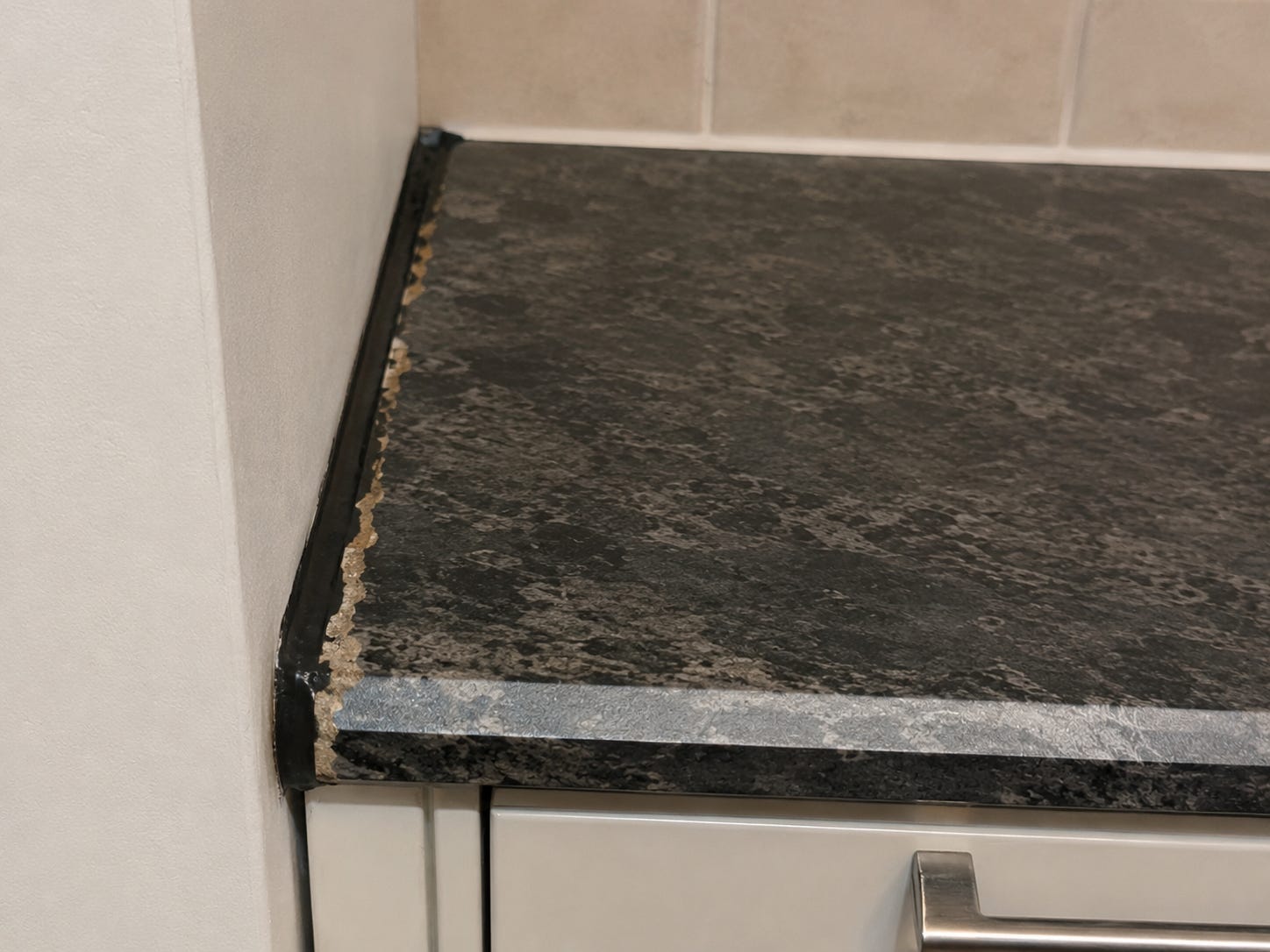
Above: An illustrative reconstruction. The image shown is not the actual one from the property.
He then ran white sealant around the back edge to match the tiles. Because he hadn’t scribed the worktop to the wall, there were large gaps to fill, at certain points you could fit your fingers along the back.
Just picture that for a moment. Huge gaps filled with sealant trying to disguise a worktop that should never have been fitted in the first place.
I remember just shaking my head. I questioned the quality of this job.
I remember saying something along the lines of “Would you do that in your own house?”
He didn’t hesitate. In his view, that was exactly what sealant was for. I pointed out that sealant wasn’t there to disguise a gap that wide, but he took offence at the criticism. He argued that it didn't matter because the tenant's microwave normally sat in that corner of the worktop and would hide the gap from view. As far as he was concerned, if it couldn't be seen, it wasn't a problem.
That comment probably told me more about his attitude than the poor workmanship itself.
I could tell my comments had annoyed him because afterwards I found out that he told the planners not to pair me with him again. Apparently, he “preferred other ops.”
Looking back, what frustrates me isn’t that he made a mistake. Every tradesperson makes mistakes. The difference is that when you take pride in your work, you own the mistake and put it right. You don’t spend more time trying to hide it than it would have taken to correct it.
The bigger problem, though, wasn’t just him. It was the system that rewarded him. His productivity figures looked fantastic because he rushed through jobs, but nobody seemed interested in how many of those jobs someone else had to go back and rectify. If all you’re measuring is how many repairs someone completes, without looking at whether they were done properly first time, you’re only seeing half the picture.
The people who paid the price were the tenants. If they challenged the standard of the repair, they then had to wait in for another appointment, put up with further disruption and lose confidence that the work would ever be completed properly. Many just suffer the work just to avoid the inconvenience and become grateful for the poor standard of work completed.
His colleagues paid the price too. Instead of getting on with their own work, they were often sent back to rectify somebody else’s (The system at the time allocated recall jobs to whoever was available first). This in turn affected their own jobs-per-day figures subjecting them to criticism from their superiors. Ironically, the operatives who took the time to do things properly often looked less productive on paper than those creating the problems in the first place.
What surprised me most wasn’t just what happened that day, but what happened afterwards. A few years later, he moved to another area and was promoted to supervisor on another patch. That meant someone whose approach to workmanship, time management and accountability had, in my experience, repeatedly fallen short was now responsible for overseeing other tradespeople, setting standards and signing off repairs.
It left me wondering what message that sent to the operatives who took pride in doing things properly. Supervisors don’t just manage workloads; they shape expectations, influence behaviour and help define an organisation’s culture. When people displaying the wrong behaviours are promoted into positions of responsibility, those behaviours risk becoming normalised. If organisations reward the wrong behaviours, they shouldn’t be surprised when those behaviours become embedded in the culture.
The job I've described happened some time ago, but spend any length of time walking around social housing and you'll still see the consequences of employing or contracting people who lack the necessary skills, experience, professionalism or respect for the homes they're working in.
You see it in communal areas where mismatched stair nosings have been fitted, handrails have been patched together using different components or repairs have clearly been carried out with whatever happened to be on the van rather than the correct materials. You see mismatched window handles, replacement doors that don't line up with existing frames, pipework boxed in as an afterthought, sealant smeared over gaps instead of defects being corrected, sockets and switches fitted out of line, poorly cut flooring, kitchen worktops that don't meet walls properly, and architraves or skirting boards pieced together from different profiles because "it'll do."
Put together, all of this suggests a repairs service where getting somebody on the ground has become more important than getting the right person on the ground. They reflect the consequences of poor recruitment, inadequate supervision, low expectations or, in some cases, an attitude that social housing tenants should simply accept a lower standard.
Whenever people talk about improving repairs services, the conversation usually turns to technology, AI, scheduling software or performance dashboards. Those things all have their place, but far less attention is given to the people carrying out the work; their trade skills, their values, the pressures they work under, the standards they're expected to meet and, ultimately, the pride they take in their workmanship. Without that, no amount of technology will ever deliver a quality repairs service.
It's one of the reasons I've increasingly found myself writing about the people behind the repairs rather than just the repairs themselves. The more time I've spent reflecting on my own experiences, speaking to others in the sector and researching the subject, the more convinced I've become that if social landlords want to improve repairs services, the sector needs to better understand the workforce delivering them.
In my Bristol University Press article on the social housing workforce, I explored how recruitment, training, performance management and organisational culture all influence the standard of repairs tenants receive. Throughout Middle Ground, I tried to paint a picture of life working on the frontline, the competing demands, resource pressures, workload, management decisions and the emotional toll that can come with working in people's homes. I also dedicated an entire chapter, The Weight of the Job, to the pressures tradespeople face every day and how those pressures can affect the quality of their work. In another article on my Substack, Maintenance Operatives: Jack of All Trades, Master of One (But Pushed Into Many), I questioned why the sector is recruiting people into roles that demand a breadth of skills that no single person can realistically master.
The more I’ve researched and written about the subject, the more I’ve realised there is rarely one simple explanation for poor workmanship. It can stem from poor recruitment, inadequate training, unrealistic workloads, weak supervision, staff and skills shortages, or a culture that values quantity over quality. More often than not, it’s a combination of several of these factors.
But every now and then, none of those explanations really fit. Sometimes, it simply comes down to attitude.
The overwhelming majority of tradespeople I’ve worked with throughout my career would never accept that attitude. They take pride in every repair, regardless of whether it’s a council flat or a £2 million house. Good workmanship has nothing to do with the postcode. It comes down to the standards you set yourself, even when nobody else is watching.
Joe
This is a fascinating insight - agreed, everyone deserves a good home, no matter whether it's a whether it’s a council flat or a £2 million house. People should always remember the complaints procedure to their council to get things rectified, as without it, these issues don't get surfaced.